What Self-Driving Trucks Could Mean For Your Next Delivery
Can a line of trucks rumble down the highway by themselves? That’s the plan.
This story appears in the October 2016 issue of Entrepreneur. Subscribe »
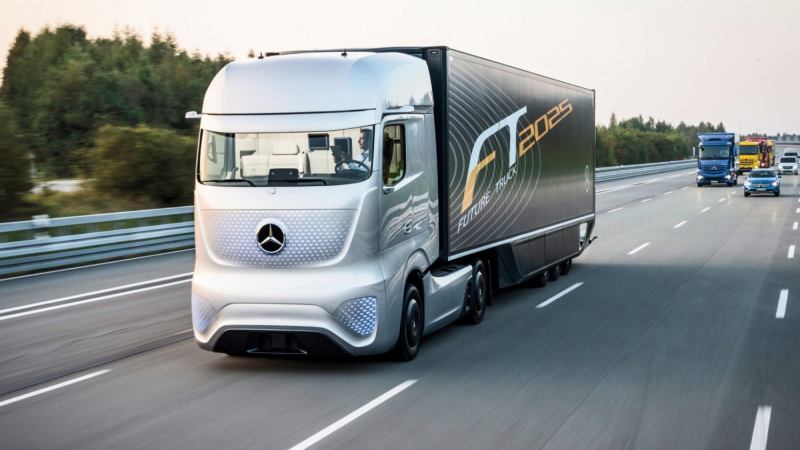
Picture this: You’re driving down a highway, behind a pack of tractor-trailers. As you pass the truck in the back, you notice that its driver’s seat is empty. Next one, same thing. And again. All these trucks are being driven by themselves. Finally, when you reach the lead truck, you’re relieved to see a human behind the wheel. Except then you realize that the driver is reclined in his seat, flipping through a magazine.
This could be the future of long hauling, led by autonomous trucking platoons. It’s not just a hypothetical; it’s something the world’s largest auto companies are developing right now.
Related: Your Next Company Car Might Be an Uber
Automotive giant Daimler is currently testing its autonomous trucking system with Freightliner Inspiration trucks in Nevada and Mercedes Highway Pilot trucks in Germany. Cameras and radar mounted in the lead truck scan the road ahead in various lengths and widths, gathering data on lane markings, distant traffic patterns and even peripheral vehicles that could cut off the truck. That info is fed into computers that handle steering, acceleration and braking for the entire line. If the system can be mastered, teams of self-driving big rigs could eventually wind their way across our interstates, safely and efficiently transporting products.
That future is still at least 10 years away. “Large variations in lane markings, the behavior of other road users, and changing weather conditions mean significant testing is still needed,” says Derek Rotz, director of advanced engineering for Daimler Trucks North America. “This takes time.”
Still, lessons are pouring in, leading to advancements that will improve trucks long before they go driverless. Daimler says its motivation is to improve road safety; after all, most vehicle accidents are caused by human error. It also wants to smooth traffic flow. But its automated system could also mitigate a looming problem in the industry: a lack of labor.
Related: The Flying Car Might Be Your Next Company Car
“We’re experiencing a driver shortage in the U.S.,” says Amelia Regan, professor of computer science and transportation systems engineering at the University of California, Irvine. “With long hours and low wages, it’s not an attractive job anymore. Autonomous trucks will make long hauling more alluring.” They’re also expected to save business owners a nice chunk of change, thanks to lower fuel and repair costs: Synced-up, autonomous trucks should be able to follow each other with just 50 feet between vehicles, instead of the industry-standard 165 feet. Narrower gaps mean less aerodynamic drag, increasing gas mileage and reducing wear and tear on the vehicles themselves.
But there is a potential downside: slower deliveries. “Human truckers are paid by the mile, so they inherently drive more quickly than is efficient in terms of fuel economy,” Regan says. “Autonomous platoons may drive more slowly because they’re looking to lower gas usage.” But the bragging rights that come with delivering your goods via phantom drivers? That may just make up for it.
Picture this: You’re driving down a highway, behind a pack of tractor-trailers. As you pass the truck in the back, you notice that its driver’s seat is empty. Next one, same thing. And again. All these trucks are being driven by themselves. Finally, when you reach the lead truck, you’re relieved to see a human behind the wheel. Except then you realize that the driver is reclined in his seat, flipping through a magazine.
This could be the future of long hauling, led by autonomous trucking platoons. It’s not just a hypothetical; it’s something the world’s largest auto companies are developing right now.