Conrad Thompson Runs a Successful Mortgage Brokerage and Pro-Wrestling Podcast Empire. The Two Are Not Mutually Exclusive.
The 40-year-old entrepreneur talks about how wrestling fandom led to the ultimate side hustle and why it all helps his family-owned real-estate business’s bottom line.
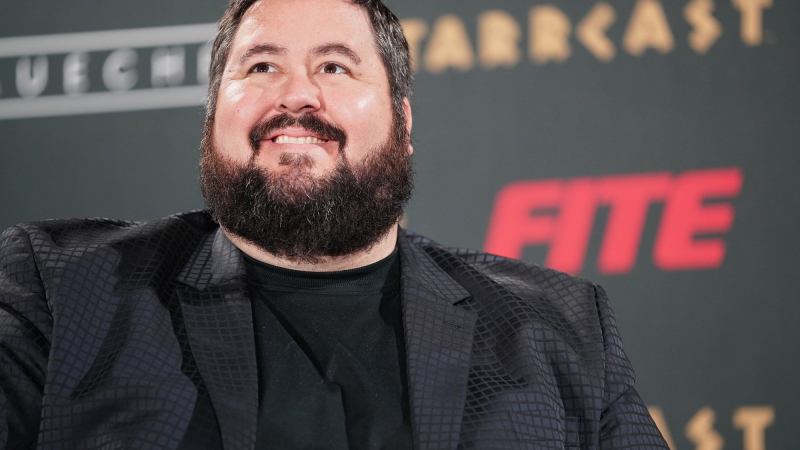
Don’t be fooled by Conrad Thompson’s genial Southern manner: The man is all business. Two decades ago, the 40-year-old Alabama native ventured into real estate. By 2006, he and several relatives opened shop at 1st Family Mortgage Company in Huntsville, where Thompson was born and raised and still lives with his wife Megan Fliehr, who also happens to be the daughter of pro-wrestling legend Ric Flair. But that fact alone doesn’t quite explain how Thompson wound up co-hosting and overseeing a series of hugely popular wrestling-themed podcasts alongside squared-circle icons like Kurt Angle and Arn Anderson.
A child of the ’80s and Hulkamania, Thompson renewed his wrestling fandom around the mid-aughts. In 2012, he and some friends helped fund a documentary on 1990s renegade wrestling promotion ECW via Kickstarter. Soon after, they paid provocative industry fixture Jim Cornette to do an unfiltered interview from Thompson’s living room. Before long, Thompson was introduced to and struck up a friendship with Flair, who invited Thompson onto his now-defunct podcast. Fast forward to 2016, and Thompson joined forces with current World Wrestling Entertainment executive Bruce Prichard for a show called Something to Wrestle With that initially aired via WWE Network.
Today, Thompson’s AdFreeShows podcast network — anchored by Something to Wrestle With — boasts seven weekly shows that he co-hosts and curates (in addition to other periodic original content) while attending to 1st Family Mortgage. That is the point, as ads for 1st Family are baked into the podcasts, and both endeavors are promoted synergistically across his websites and social media channels. Given that AdFreeShows has amassed more than two million downloads in the U.S. alone, that’s the kind of referral business word of mouth alone can’t buy.
On a recent fall morning, following a late-night recording session with Prichard and amid daytime duties for 1st Family, Thompson talked with us by phone from his Huntsville office about wearing different hats, merging disparate passions and what makes quality podcasts click.
Do people still have a hard time understanding how your two businesses overlap?
I think a lot of people were probably scratching their heads when I explained here at the mortgage office that I was going to find a way to dovetail wrestling podcasts into it. But for years, we promoted our mortgage company through traditional advertising like radio, and we were spending pretty hefty sums for a small business — over a hundred grand a month. All of a sudden, I realized, “Wait a minute. Through these podcasts, our commercials can be heard nationwide, and it’s no money out of pocket for me. So, if there’s perhaps more penetration and less out of pocket, that’s a win-win.” So instead of borrowing someone else’s stick, as they say in the radio business, now we have our own sticks and create our own relationship with the audience. But man, it’s worked out tremendously because people do business with who they know, like and trust. A lot of folks are aware of our business because of the podcast. It’s working out.

So there’s no point at which you’re going to feel forced to choose one gig over the other?
No. I mean, I started doing podcasts to sell mortgages. I know that that doesn’t make sense for people who first became aware of me through the podcast, but I saw it as an advertising opportunity to take my mortgage company nationwide, and it’s worked. I don’t think there’ll ever be a time where I say I just want to do mortgages, because I’m always going to need to advertise. And I don’t think there’ll be a time where I say I just want to do podcasts and forego the thing I’ve done now for more than 20 years. We’ve built a nice business here, and a bunch of folks are relying on me, and to me, they just go together like peanut butter and jelly.
Just to illustrate your point, how much has business boomed for 1st Family since you started podcasting?
Overall, our company’s at 1,400% [growth] in the last five years, so it’s been phenomenal. I can’t credit all that to the podcast, but as far as the wrestling-podcast piece, it has definitely grown exponentially beyond what we had originally imagined.
Have you noticed any similarities between how trends in the mortgage business and podcasting world ebb and flow?
Well, certainly, the more listeners we have on the podcast, the more opportunity we’re going to have to generate business on the mortgage side of things, and things went absolutely crazy during COVID when folks were stuck at home. And I do think they were listening to terrestrial radio less because there was less “windshield time,” but they were still working at their desks, so we did enjoy quite a bit of growth on the podcast side through the pandemic, specifically with our other arms of our business, like Patreon.
But in addition to that, we saw [mortgage] rates just become lower than ever. All of a sudden folks realize, “Hey, I don’t have to live in a high rise. I can get out of town and have a yard.” When people started to work from home and they realized that there might be tax benefits to that, they no longer had to think about a crazy commute. It really created a lot of opportunity on both the refinance side of our mortgage business and the purchase side.
So it’s kind of weird because most people would say the wrestling business is enjoying a resurgence, but when you take a look at fanfare and ratings and things like that, I don’t know that it was up through the pandemic. But it was on the mortgage side and, and certainly, podcasting has grown year-over-year. And I think that the wrestling fan base, while it may be diminished from what it was at its peak, is more passionate now. So there may be fewer fans, but they’re more loyal fans and are more apt to spend money.
You are ultimately spreading yourself pretty thin. What’s you’re coping strategy for burnout?
I’ve been blessed to have really great support teams on both sides. We have a team that helps me with research, graphics, video, ad sales and merch on the podcast side of things. I’ve really got it drilled down to where I chart the course, but outside of that, all I have to be is on-air talent, and that just becomes a function of setting up a recording schedule.
We’re really fortunate that if I have to be out of town for travel, I’ve got a great number two where I can just tag in [AdFreeShows fill-in host] Paul Bromwell, and he does a great job in my absence. As long as we’re delivering my ad reads for the advertisers, everyone seems to be OK. That’s not something I try to lean on too much, but I turned 40 over the summer and took a week off, and it was phenomenal. It gave me an opportunity to be away and not be feeling like, “Oh, I should be there,” because I knew Paul had my back. So I would expect that to happen at least once a year moving forward.
Related: Meet the Pro-Wrestling Pair That’s Building a Small-Business Empire
A lot of small-business owners have tried to launch podcasts, with mixed results. Yours are only tangentially related to your real estate operation, but what have you learned in general about the medium and when it resonates with audiences?
I’ve got a lot of friends in both the real-estate world and the finance world who have tried the podcast thing, but I think their mistake is they make the podcast about the business. And frankly, nobody cares about your business but you, and that took a long time for me to figure out, because I felt like that’s what everyone wanted me to do. But if I just did a mortgage podcast, I mean, gosh, I’d have hundreds of listeners, not hundreds of thousands of listeners. I’m sure some people will read that and think, “Hey, that would be great if I had hundreds of listeners.” Well, but what if you could have hundreds of thousands of listeners? What you’ve got to find is something that you’re passionate about, and it’s really a rifle shot and not a shotgun approach because, man, talking about old nostalgic wrestling from the ’80s and ’90s is about as niche as it gets, but we found a way to grow an avid fan base.
And now we’ve been fortunate enough that any time I spin off a new show, there’s going to be support there because the audience is already familiar with our style and our way of doing things; we’ve got a little bit of loyalty and some equity built up. If you can create an audience, then you can tell them about your business, but it shouldn’t be, “I’ll make it about my business, and the audience will come.” Everyone who listens to our podcasts knows they’re going to have to sit through a doggone mortgage commercial, but for the other 90 minutes, we’re going to give them what they want, which is all wrestling content. The challenge for anyone who wants to copycat what I’ve done is this: What’s your pro wrestling? What is your passion? What is your topic? If you figure that out and then find a way to plug your business as part of that show, now you’ve got something.
Don’t be fooled by Conrad Thompson’s genial Southern manner: The man is all business. Two decades ago, the 40-year-old Alabama native ventured into real estate. By 2006, he and several relatives opened shop at 1st Family Mortgage Company in Huntsville, where Thompson was born and raised and still lives with his wife Megan Fliehr, who also happens to be the daughter of pro-wrestling legend Ric Flair. But that fact alone doesn’t quite explain how Thompson wound up co-hosting and overseeing a series of hugely popular wrestling-themed podcasts alongside squared-circle icons like Kurt Angle and Arn Anderson.
A child of the ’80s and Hulkamania, Thompson renewed his wrestling fandom around the mid-aughts. In 2012, he and some friends helped fund a documentary on 1990s renegade wrestling promotion ECW via Kickstarter. Soon after, they paid provocative industry fixture Jim Cornette to do an unfiltered interview from Thompson’s living room. Before long, Thompson was introduced to and struck up a friendship with Flair, who invited Thompson onto his now-defunct podcast. Fast forward to 2016, and Thompson joined forces with current World Wrestling Entertainment executive Bruce Prichard for a show called Something to Wrestle With that initially aired via WWE Network.
Today, Thompson’s AdFreeShows podcast network — anchored by Something to Wrestle With — boasts seven weekly shows that he co-hosts and curates (in addition to other periodic original content) while attending to 1st Family Mortgage. That is the point, as ads for 1st Family are baked into the podcasts, and both endeavors are promoted synergistically across his websites and social media channels. Given that AdFreeShows has amassed more than two million downloads in the U.S. alone, that’s the kind of referral business word of mouth alone can’t buy.