Where Are You Gonna Work Today? The Death of the 8-Hour Desk.
Have you considered having your office receptionist do double duty as your company barista?
Opinions expressed by Entrepreneur contributors are their own.
Over half a century ago, companies began converting private offices into open workspaces. The move seemed like a good way to save money, because it used office space more efficiently.
Related: Office Design? You Need to Do These 3 Things To Reduce Employee Distractions.
More recently, millennials have made shared workspaces the new world order, particularly in startup environments, where the dynamic is thought to uplift employee morale and increase collaborative creativity.
Yet, as laptops and smartphones have enabled employees to connect from anywhere via their “mobile office,” the inevitable question has become, “Why even come to the office?”
The truth is, neither open floor plans nor telecommuting options are close to perfect environments. “The former has been shown to hinder workplace productivity,” reported the Huffington Post, “while the latter can stifle collaboration.”
Numerous studies show that open offices actually destroy productivity. They lead to more distractions, higher stress levels and more sick days. While employees who work in open offices may feel that they are part of a more laid-back, innovative work culture, they actually suffer more interruptions, get less work done and have less motivation.
According to a January 2017 BBC article that cited a University of Sydney study: “Small distractions can cause us to lose focus for upwards of 20 minutes.” The article continued that, “Nearly 50 percent of people with a completely open office floorplan, and nearly 60 percent of people in cubicles with low walls, are dissatisfied with their sound privacy. Only 16 percent of people in private offices said the same.”
Clearly, we all yearn for a productive, yet modern office space, and we don’t want employees heading to the nearest Starbucks to get the privacy and solitude they need to actually get something done. So, how can you design your next office to foster employee productivity, yet still be inviting to millennial and Gen Z employees and colleagues?
Environmental choices
The answer is to offer employees environmental choices that match their respective tasks.
Related: Why Steve Jobs Obsessed About Office Design (And, Yes, Bathroom Locations)
Giving your teams multiple places to work not only boosts productivity, but morale and retention, as well.As a June2017 Gallup news article put it, “Employees who have the ability to move to different areas at work are 1.3 times more likely to be engaged than other employees.”
Here at Officemorph, we recently remodeled an office space built out 20 years ago for a client who had a workplace filled with tall, cavernous cubicle partitions.Noise was the client’s chief complaint and the company didn’t want to part with its high cube walls.By creating alternative spaces for casual conversations and face-to-face interaction, we solved the noise problem by not confining staff to their desks the entire day.
Interested in a design change? To craft a new office that everyone will be excited about, include the following types of spaces:
The “living room”
Using comfortable furniture that take cues from the hospitality industry, build spaces where employees can bring their laptops for an hour or two. We’re seeing more corporate kitchens that are not just used for lunch breaks but are venues that have been fitted for conversation without tying up a formal conference room or imposing noise on other people at their desks.
The “phone booths”
Make plenty of private rooms just big enough for one or two people to make a phone call. This will provide privacy and minimize disruptions in open areas.
The “library”
Create an enclosed, quiet room with multiple desks where people can come to read, write or think. Consider piping in some peaceful music.Enforce one important rule here: no talking.
The “lounge”
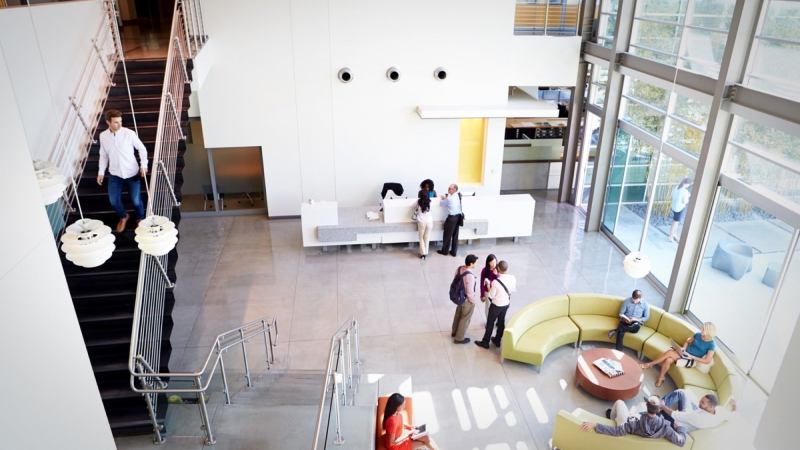
Reception areas have evolved in the corporate environment.Many companies don’t need a big reception area and instead have put this space to use for yet another option for sitting, work or chats.We’ve seen a few companies that have joint “receptionist-baristas,” as coffee bars have moved to the front of the office, encouraging meetings with guests to stay at the front of the office.
“Home base”
Every employee needs a workstation to call his or her own and store personal/work belongings. Progressive firms have made work surfaces as small as 2 x 4 feet to allow for more collaborative spaces like phone booths and living rooms.
Why is your employees’ workspace so crucial to the success of your company? While entrepreneurs have zeroed in on their customers’ user experience, employee UX is actually just as important to the equation if you want happy, productive and loyal employees. As a February 2016 Strategy-Business.com article put it, “Your employees’ user experience should be a strategic priority.”
Related: The Science of Office Design
With work increasingly becoming something that can be done from anywhere, and open-concept shared workspaces missing the mark on productivity, the multi-environment workspace is a progressive approach for employers, and one you should consider for your brand.
Over half a century ago, companies began converting private offices into open workspaces. The move seemed like a good way to save money, because it used office space more efficiently.
Related: Office Design? You Need to Do These 3 Things To Reduce Employee Distractions.
More recently, millennials have made shared workspaces the new world order, particularly in startup environments, where the dynamic is thought to uplift employee morale and increase collaborative creativity.