Inside Fintech Success
Lessons learned to become a great entrepreneur
Aug 07, 2025
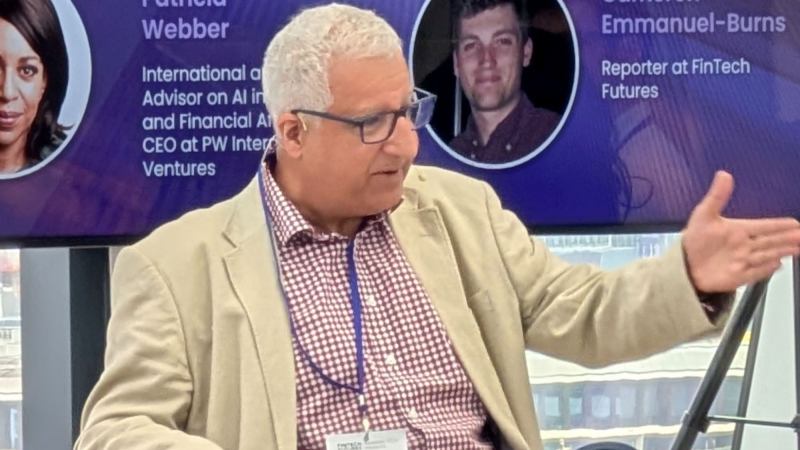
Farshad Nowshadi at FinTech Futures
Farshad Nowshadi blends experience with a sharp vision that doesn’t just keep pace with the global financial ecosystem – it’s helped shape it. With over three decades in financial services – spanning global consultancy roles at Reuters Financial Services to mentoring early unicorns such as Revolut and WISE to helping testablish blu Bank, the Middle East’s leading mobile-first bank going in 4 years to also become the fifth largest Mobile bank in the world with 14 million users, Nowshadi helped to foster the brilliant start-up teams that bridged the legacy systems of traditional banking with bringing convenience, ease of use and just fun into a banking interface.
Having backed Google and Amazon in their early days, he brings a rare blend of first-hand tech insight from those formative years and a sharp foresight for the future, making him a key voice on AI for start-up and VC communities in 2025. His career reflects an ability to not only spark growth but sustain it – a testament to the kind of long-term resilience and strategic thinking that financial technology demands. Nowshadi’s openness to sharing the hard-earned secrets of his success was clear from the get go. “I’ve learned invaluable lessons and strategies – now, my goal is to pass them on,” he says.
Lesson one: Understand before you act
In the 1980s, while at Learning Tree International, Nowshadi was instrumental in guiding CEOs and CTOs of major banks through the early implications of the internet for all their financial services — offering a glimpse into the digital future of financial services well before the industry’s full transformation began. “There was much confusion at that time,” he recalls, drawing a parallel to today’s turbulence around AI and blockchain. “What I learnt was that a clear understanding from the beginning was paramount… a lot of people pretended, but they didn’t really understand,” he reflects – a lesson that would shape his approach to innovation and leadership in the years to come.
Likewise, as artificial intelligence continues to attract both excitement and uncertainty, Nowshadi stresses the need for clarity over clatter. For entrepreneurs, he says, that means turning to credible sources and building a thoughtful, informed perspective – not simply getting swept up in the hype. “We all talk about LLMs and AI agents, but it’s crucial to find ways to grasp these concepts in a straightforward, accessible way.” He also warns against relying on surface-level knowledge: “Don’t overwhelm yourself – take the time to analyse the topic through trusted sources and ensure you have a deep, solid understanding.” This solid foundation, he explains, is essential: “With the right knowledge, you’ll be able to make more informed decisions – whether it’s about where to invest or how to navigate key entrepreneurial choices. It’s about cutting through the noise and identifying what really matters.”
Lesson two: Data is king – especially real-time data
Nowshadi’s tenure as a global consultant at Reuters Financial Services – a company built on the value of real-time, precise information – shaped his understanding of the power of data. “As the information gets delayed, its value diminishes,” he explains.
This experience cemented his belief that effective management of current data is essential for success. “Whoever controls the freshest data controls a tremendous amount of business.” He points to Google as a prime example of this in action, a company he invested in early on. “They’ve mastered the art of bringing the world’s data to us in real time, and look at the success they’ve achieved. Because, in the end, data is king.”
With the rise of AI, Nowshadi offers a clear warning: “You can talk about the most advanced LLMs or AI agents, but it all boils down to the quality of the data they’re working with. In computing, there’s a term called GIGO – garbage in, garbage out. To make meaningful, high-stakes decisions, you must control your data. The more current and accurate it is, the more valuable it becomes.”
Lesson three: Customer obsession is a non-negotiable
One of the most defining moments of Nowshadi’s career came during his time working with the “Greenhouse Fund,” an incubator within Voices Financial Services, where he had a front-row seat to Amazon’s evolving culture. He and his team would quietly listen in on customer calls to understand how companies were truly interacting with their customers.
What struck him most about Amazon was their unwavering commitment to customer satisfaction: “They were 100% focused on the customer. If there was any doubt, they’d refund your money or return your goods – no questions asked. And they pioneered that one-click checkout.” He puts it simply: “It’s all about customer satisfaction, isn’t it?”
For entrepreneurs, Nowshadi stresses that prioritising customer experience is the foundation of lasting impact: “The most successful entrepreneurs are the ones who laser-focus on customer satisfaction. These are the core principles that will shape future success.”
Lesson four: Seek unbiased feedback – don’t rely on friends and family
Nowshadi’s stint on MasterChef in 2016 provided him with a surprising yet valuable lesson in entrepreneurship. “I’d cook all these dishes and ask my friends and family what they thought. Of course, they were totally biased – ‘Oh, Farshad, this is great, they’d say.’ But the real insight came when a judge pointed out the inconsistent flavours in a dish – something Nowshadi hadn’t noticed.
The takeaway? “As an entrepreneur, you have to ensure the feedback you’re getting is genuine and impartial, not sugarcoated. Don’t ask your friends and family. Don’t seek validation from those who are emotionally invested. They’ll tell you how clever you are, but that’s not real feedback.”
Lesson five: Know when to quit
Entrepreneurship isn’t just about starting up. Sometimes, it’s about shutting down. Nowshadi reflects on an experience from his time in Iran, where, between 2005 and 2010, he launched an early Amazon-style platform called BazIran (The Bazaar of Iran) , attracting 100,000 users. “It didn’t work, internet service was poor, expensive and people just were not prepared to pay online in those days and only wanted Cash on Delivery. The market wasn’t ready,” he admits. Despite the struggles, he hesitated to close the venture, allowing it to drag on until the situation worsened. His takeaway? “Sometimes, businesses aren’t working. You have to recognise it and shut them down. That’s a critical skill – knowing when to pivot or walk away.”
For Nowshadi, this ability to step back is as vital as the art of building a start-up itself. “One of the classic things I always say is: if you want to build the most beautiful house, build it, then knock it down and build it again. You learn so much through that process.”Highlighting a cultural divide, he says, “In America, people respect those who fail and come back stronger. In Europe, however, failure is often overlooked or dismissed. But I believe failure is a crucial part of learning and growth.” Through this, he hopes to emphasise the value of recognising when something isn’t working.
Beyond the lessons:
While the lessons above serve as a blueprint for any entrepreneur, Nowshadi’s story is far from one-dimensional. He brings a wealth of experience from mentoring early unicorns like Revolut and WISE, as well as from his hands-on work with blu Bank. His understanding of both traditional banking and cutting-edge fintech allows him to bridge worlds, bringing an innovative mindset to every venture he touches.
Mentoring:
“I loved mentoring early unicorns like Revolut and WISE,” says Nowshadi. He recalls meeting Revolut founder Nikolay Storonsky in 2014. “I came across this cheeky chap called Nikolay. I remember thinking, wow, this guy’s ambitious.” What stood out most was Storonsky’s personal financial commitment: “He was ready to invest a significant amount, think it was around £100,000 of his own money. I admire that – someone who backs their ideas with their own funds.” Nowshadi admits his traditional banking background made him cautious: “It takes 30 years to build a reputation, but only five minutes to lose it.” While regulatory challenges remain for Revolut, he praises their growth. Similarly, he lauds WISE founders Taavet Hinrikus and Kristo Käärman, who revolutionised currency exchange. “They were fed up with the fees banks charge. The idea of a peer-to-peer platform charging a fraction of a percent was brilliant.” Today, he notes, “Look at them – they’re number one.”
Building the Middle East’s largest mobile bank
Nowshadi recalls that during the early establishing phase of blu Mobile Bank, to overcome early credibility challenges and ensure efficiencies, it was a pivotal decision to ensure blu Bank partnered with a larger bank for regulatory support while building the software and customer experience from the ground up.
He contrasts the efficiency of the Mobile -bank model with traditional banking: “A traditional bank might serve four or five million customers with 11,000 employees. At blu Bank, we have 14m customers with just a few hundred workers.” Operating without physical branches, blu Bank excels in usability and its executive focus on true customer convenience.
Reflecting on the limitations of legacy infrastructure, Nowshadi adds, “The next generation of banks, which often will be around DeFi concepts, will need to start with a clean slate, not rely on legacy banking inefficient systems.” He concludes, “Don’t reinvent the wheel – offer better service, more convenience, and lower costs for customers.”
The AI tsunami: Embrace or become redundant
Looking ahead, Nowshadi views AI as an undeniable disruptive force. “There’s a tsunami of change coming. It’s not just a tool – whether you’re a florist, a writer, or a businessperson – AI will touch every corner of life.” He warns, “The real question is: Will you harness this technology for your benefit, or will you become redundant?”
Looking ahead, he predicts that AI agents will soon take on senior roles – potentially managing entire businesses with minimal human involvement – acting as department heads with clear strategies and dedicated resources. Optimistic about AI’s potential to democratise expertise globally, Nowshadi highlights the opportunities across the medical field: “Anyone, anywhere – whether in rural India or Afghanistan – could potentially access top-tier medical advice by uploading their images and getting the best consultants.” Yet, he raises concerns about oversight: “Who will these AI agents be accountable to? I don’t think the answer can be regional, it must be an international standard, possibly overseen by organisations like the United Nations.”
A vision for a global future
Nowshadi envisions a future where governance transcends borders, with global standards replacing traditional systems. “I believe in universal suffrage and a world more like the United Nations,” he says. He foresees AI agents replacing governments, creating a future of abundance and fairness.
Drawing from his vast experience in banking and fintech, Nowshadi’s parting advice to entrepreneurs: “Understand deeply, focus on customers, embrace real-time data, seek honest feedback, and know when to pivot. The future is fast – don’t wait until it’s too late.”
Farshad Nowshadi blends experience with a sharp vision that doesn’t just keep pace with the global financial ecosystem – it’s helped shape it. With over three decades in financial services – spanning global consultancy roles at Reuters Financial Services to mentoring early unicorns such as Revolut and WISE to helping testablish blu Bank, the Middle East’s leading mobile-first bank going in 4 years to also become the fifth largest Mobile bank in the world with 14 million users, Nowshadi helped to foster the brilliant start-up teams that bridged the legacy systems of traditional banking with bringing convenience, ease of use and just fun into a banking interface.
Having backed Google and Amazon in their early days, he brings a rare blend of first-hand tech insight from those formative years and a sharp foresight for the future, making him a key voice on AI for start-up and VC communities in 2025. His career reflects an ability to not only spark growth but sustain it – a testament to the kind of long-term resilience and strategic thinking that financial technology demands. Nowshadi’s openness to sharing the hard-earned secrets of his success was clear from the get go. “I’ve learned invaluable lessons and strategies – now, my goal is to pass them on,” he says.
Lesson one: Understand before you act
In the 1980s, while at Learning Tree International, Nowshadi was instrumental in guiding CEOs and CTOs of major banks through the early implications of the internet for all their financial services — offering a glimpse into the digital future of financial services well before the industry’s full transformation began. “There was much confusion at that time,” he recalls, drawing a parallel to today’s turbulence around AI and blockchain. “What I learnt was that a clear understanding from the beginning was paramount… a lot of people pretended, but they didn’t really understand,” he reflects – a lesson that would shape his approach to innovation and leadership in the years to come.