He Left Law to Start a Pizza Business That Did Nearly $1 Billion in Revenue After a Crucial Pivot: ‘Don’t Fall in Love With Your Ideas.’
Rick Rosenfield put everything on the line for his California-style pizza business.
Key Takeaways
- Rick Rosenfield and his business partner, Larry Flax, left their law careers for pizza in 1985.
- Their business, California Pizza Kitchen, popularized barbecue chicken pizza.
- Rosenfield credits his ROCK framework — respect, opportunity, communication, kindness — with turning restaurants into places people wanted to work.
Rick Rosenfield still remembers the day in 1985 when he and his law partner walked out of a San Francisco courtroom and decided they were done with practicing law. Within 24 hours, they had latched onto a risky new idea, California-style pizza, mortgaging their homes and personally guaranteeing a Beverly Hills lease for their new restaurant.
Rosenfield started his career in Washington, D.C., writing Supreme Court briefs for the Department of Justice after law school.
“Then I came to California, fell in love with the weather,” he tells Entrepreneur in a new interview, recalling his move to Los Angeles to become a federal prosecutor. That’s where he met his future business partner, fellow prosecutor Larry Flax.
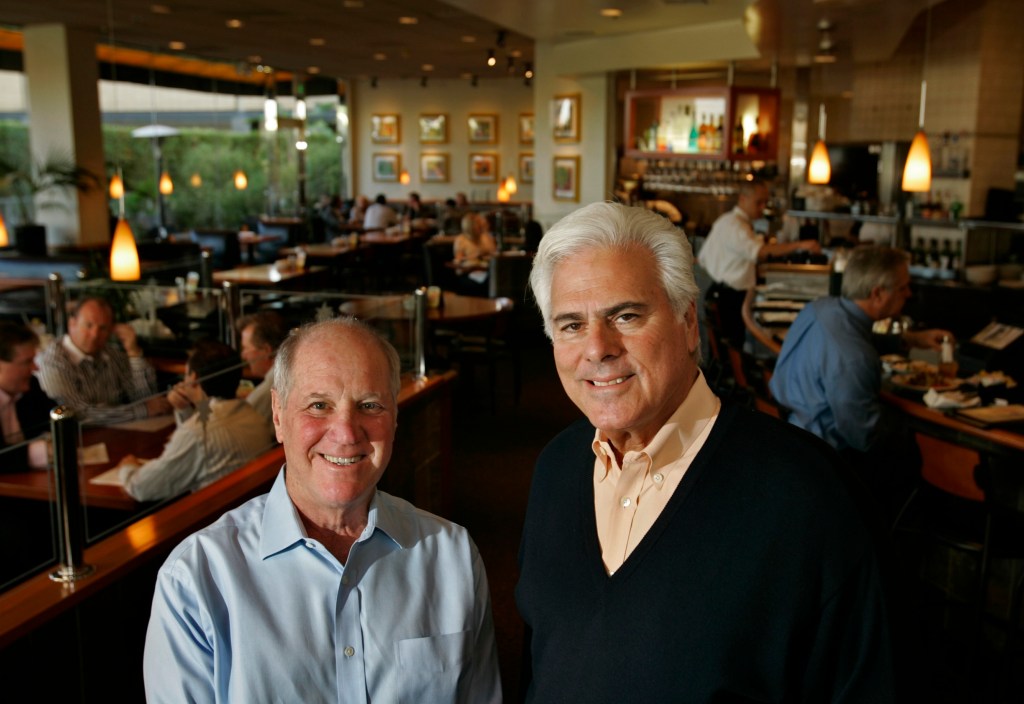
The pair eventually left the U.S. Attorney’s Office for private practice, but the itch to build something beyond billable hours kept growing. “For 12 or 13 years, we were in private practice, but really wanted to get out of the practice, really wanted to go into the restaurant business, so we created California Pizza Kitchen,” Rosenfield says. He has written extensively about the journey in his new memoir, The California Pizza Kitchen Story.
Betting on a niche
When Rosenfield and Flax started talking about California-style pizza, the category barely existed. “It was in its infancy,” Rosenfield says, tracing the term back to chef Alice Waters at Chez Panisse and chef Wolfgang Puck at Spago.
They saw a gap in how Americans in upscale neighborhoods were eating out. “Every upscale neighborhood needs a casual dining restaurant the whole family can agree on,” Rosenfield says. Pizza would be the platform that grandparents, parents and kids could all rally around.
The breakthrough came when the original chef, a former Spago talent, put barbecue chicken pizza on the menu. “Barbecue chicken pizza made it to the world…that was the light bulb, that’s what people had never seen,” Rosenfield says.
The response was immediate. On a typical day, out of 200 pizzas sold, 150 were barbecue chicken, 25 were plain cheese and 25 were everything else — a sales mix that convinced them they had a hit.
Pivoting fast
Rosenfield created CPK’s defining product from a pivot. At first, he wanted to bring a pasta cafeteria concept he saw in Chicago to California, complete with a line where customers could choose between fresh pastas and salads.
A trip to the Glendale Galleria food court in Los Angeles, a similar operation, changed his mind. “We saw this god-awful looking pizza under heat lamps. But people were grabbing a slice of pizza with their pasta,” he recalls.
That small observation changed everything. On the drive back, he and Flax started rethinking the concept: They pictured a wood-burning oven in the center of the room, a counter wrapped around it, an open kitchen and California-style pizza instead of a cafeteria line. “Don’t fall in love with your ideas,” Rosenfield says of that decision to pivot. “See what people have to say about them, keep yourself open to reality checks, and then adapt.”
The lesson for founders? “You have to be flexible. And understand your audience,” he says. His background helped: “Being trial lawyers sort of gets you ready for the unexpected sometimes.”
Growing to 200 restaurants and nearly $1 billion in revenue
CPK didn’t follow the standard franchise-first recipe. Founded in 1985, the company grew to more than 200 company-owned restaurants before Rosenfield sold the business in 2011. “Domestically, we didn’t franchise; they were all company-owned,” he says, noting that the only franchises were airports and international locations across Mexico, Asia, Dubai, India and South Korea.
It grew to 25 units in the first seven years, but things accelerated when PepsiCo came calling. “PepsiCo was the largest restaurant owner in the world…they owned KFC, Taco Bell and Pizza Hut,” Rosenfield says. PepsiCo bought two-thirds of the company, and CPK jumped from adding a handful of locations a year to 15 one year and 28 the next.
The ramp-up came with a cost. “That was the challenge that we weren’t really ready for, to build up that kind of pipeline, and then to build for that kind of growth, we ran into a wall,” Rosenfield says. When PepsiCo later decided to exit the restaurant business, it pulled back growth, leaving CPK with a machine geared to build 30 restaurants a year and no pipeline to feed it.
Even with the turbulence, the system eventually scaled close to nine-figure territory around 2011. By Rosenfield’s math, if you combined restaurant sales (about $650 million), frozen retail (around $200 million) and international and airport franchises, CPK was “pretty close to a billion dollars in revenue” — a system-wide high point.
Rosenfield and Flax sold CPK in 2011 to private equity firm Golden Gate Capital for about $470 million. After the sale, Golden Gate installed veteran restaurant executive G.J. Hart as president, CEO and executive chairman, replacing the founders as co-CEOs and ending their operational involvement with the chain. The brand later shrank and went through bankruptcy in early 2020. By November 2020, CPK announced that it had completed financial restructuring and emerged from bankruptcy with reduced debt.
People, culture and the ROCK principle
Rosenfield says that one thing made scaling possible: “People. Every step of the way, people,” he says.
Early on, he and Flax realized that a hit concept wasn’t enough. “There’s a difference between a concept and a business,” he says. “The concept would be dead in the water if it weren’t for the people.”
That value evolved into a cultural framework called ROCK: “R for respect, O for opportunity, C for communication, K for kindness,” Rosenfield explains. “We would promote rock stars, or people who could carry out our culture, people who created a restaurant where they wanted to come to work. Nobody ever had a stronger culture than California Pizza Kitchen.”
Rosenfield’s legal training also shaped how he led through ethical dilemmas. He believes his law background made him more humble because it forced him to argue and believe both sides of a case.
That mindset underpinned a simple rule at CPK: Do the right thing, even when there’s a cost. Rosenfield remembers a 1991 management conference when a manager challenged the company’s smoking policies and pointed out that servers didn’t want to work in smoking sections.
Rosenfield and Flax stepped out of the room, realized they had no good answer, and came back with a decision: “California Pizza Kitchen will be the first national chain to go non-smoking.” A day later, they extended the ban to patios after learning secondhand smoke could be worse outdoors if you were downwind.
“For all the things that we did right, the most important thing we did was our culture,” Rosenfield says.
Key Takeaways
- Rick Rosenfield and his business partner, Larry Flax, left their law careers for pizza in 1985.
- Their business, California Pizza Kitchen, popularized barbecue chicken pizza.
- Rosenfield credits his ROCK framework — respect, opportunity, communication, kindness — with turning restaurants into places people wanted to work.
Rick Rosenfield still remembers the day in 1985 when he and his law partner walked out of a San Francisco courtroom and decided they were done with practicing law. Within 24 hours, they had latched onto a risky new idea, California-style pizza, mortgaging their homes and personally guaranteeing a Beverly Hills lease for their new restaurant.
Rosenfield started his career in Washington, D.C., writing Supreme Court briefs for the Department of Justice after law school.
“Then I came to California, fell in love with the weather,” he tells Entrepreneur in a new interview, recalling his move to Los Angeles to become a federal prosecutor. That’s where he met his future business partner, fellow prosecutor Larry Flax.